Learning Guides · AI & Integrity · AI detectors
GPTZero is one of the better-tested AI detectors, and it says so with numbers. But “accurate” is not “certain”:
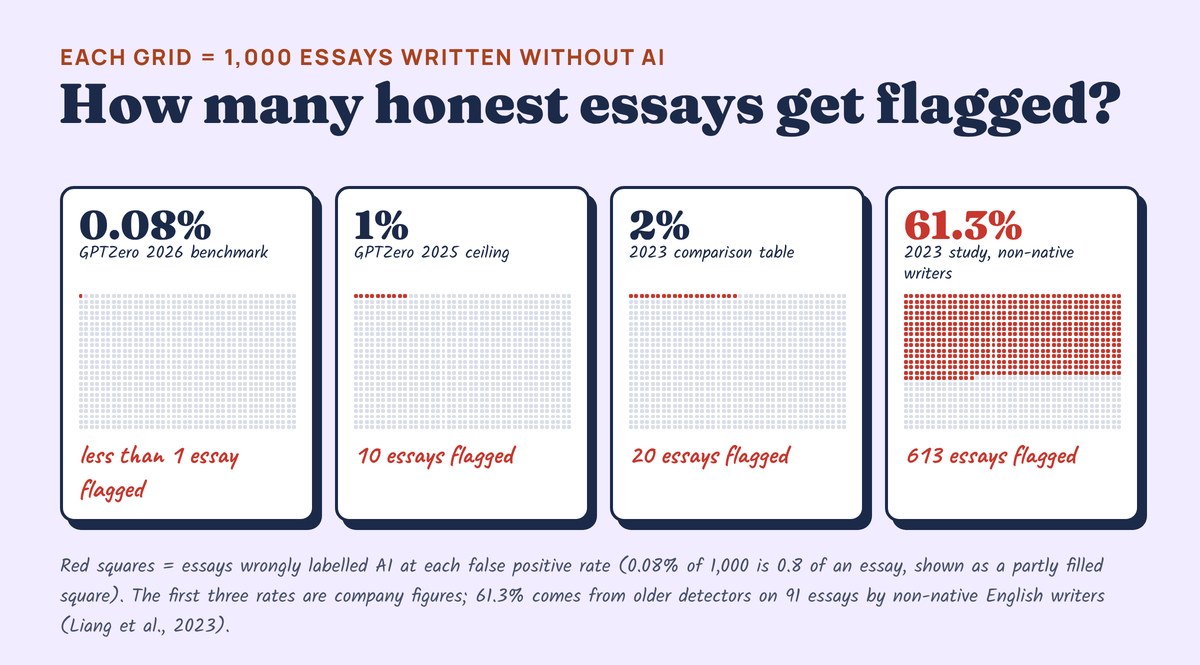
- GPTZero’s own 2026 benchmark reports 0.08% of human texts wrongly flagged. Its 2025 page promised to keep that rate at or under 1%. Both are company figures.
- Independent studies of detectors in general found them unreliable, and an often-cited 2023 study flagged 61% of essays by non-native English writers as AI.
- For a teacher, a score is a reason to talk to the student and look at the writing process, never proof on its own. Even Turnitin says so about its own tool.
About the links: this guide summarises published benchmarks and peer-reviewed research, checked in October 2026. We did not run our own detector test. Links are ordinary links; if we join a partner program later, paid links will be labelled. Our disclosure.
GPTZero’s own numbers
Two words matter when you read any detector’s claims. Recall is how much AI writing it catches. The false positive rate is how often it calls a human’s writing AI. For a classroom, the second number is the one that hurts.
| Source | Human texts wrongly flagged | AI texts caught | Note |
|---|---|---|---|
| GPTZero benchmark, Feb 2026 | 0.08% | 99.6% | Model 4.3b, average across 4 types of writing, run by GPTZero |
| GPTZero accuracy page, Jan 2025 | “no more than 1%” | 99% overall accuracy | 96.5% accuracy on mixed human + AI texts |
| GPTZero vs Turnitin table, Nov 2023 | 2% (both tools) | GPTZero 100%, Turnitin 92% | Older models; Turnitin cannot be tested freely |
Sources: GPTZero benchmark (2026) · GPTZero accuracy page (2025). AI-caught figures for 2023 are 100% minus the false negative rates GPTZero published.
To its credit, GPTZero publishes its method, versions its model and shares most test sets with researchers. Still, these are tests designed and run by the company selling the tool. Real student work is messier: short answers, drafts edited with grammar tools, writing in a second language.
What independent research found
- Weber-Wulff and colleagues (2023) tested 14 detection tools, including Turnitin, and concluded they were “neither accurate nor reliable”. Paraphrasing or editing AI text made it much harder to catch. International Journal for Educational Integrity.
- Liang and colleagues (2023) ran seven detectors on 91 TOEFL essays written by non-native English speakers. On average, 61.3% were labelled AI-generated, while essays by US eighth graders were classified almost perfectly. Simpler vocabulary looked “machine-like”. Patterns.
- A 2026 follow-up in Czech found no systematic bias against non-native writers in current detectors. Detectors have changed since 2023, but this was one language and a small study. Al Ali et al., arXiv.
A detector score tells you where to look. It does not tell you what happened.
The false-flag calculator For teachers
A small error rate becomes real students once you multiply it by a school year. Nothing is saved or sent.
The 61.3% figure comes from 2023 detectors on one small set of essays; it shows the risk for some students, not today’s average.
vs GPTZero vs ZeroGPT Similar names
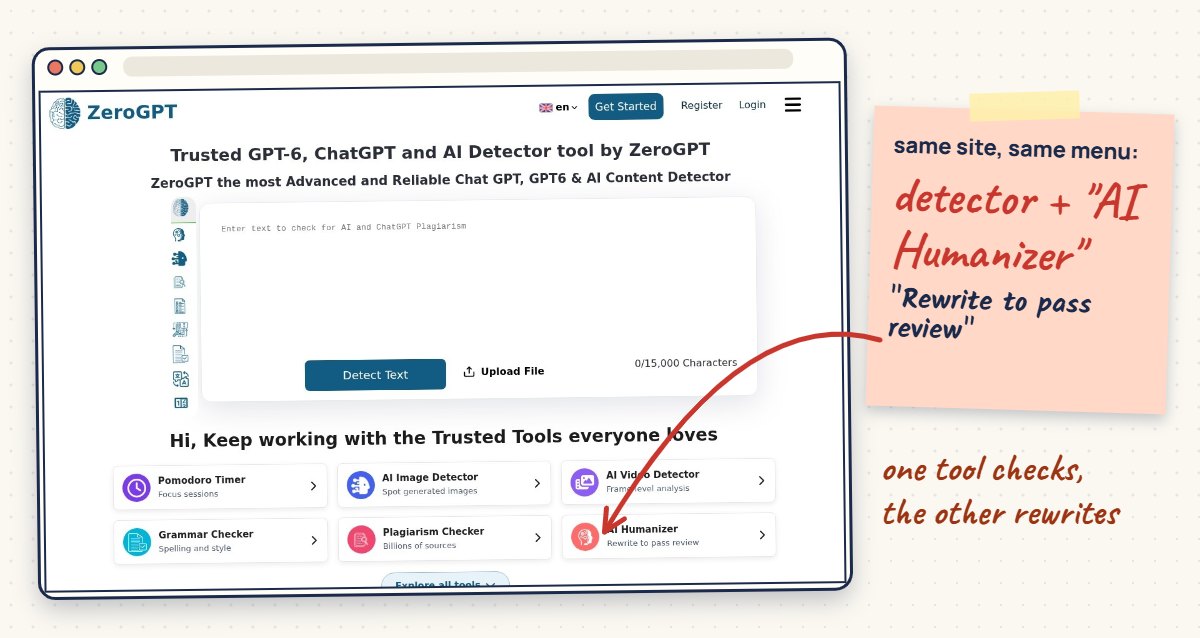
The names are close, but these are two different companies. Both offer a free text box and both advertise high accuracy: ZeroGPT’s homepage shows 98.4% detection accuracy and a false positive rate under 1%. The difference is in what you can check.
How to read a score
- Check the length. Short texts are the hardest to judge. Turnitin will not score anything under 300 words of evaluated sentences.
- Ignore small percentages. Turnitin no longer shows AI scores below 20% because false positives were more common there.
- Look at the highlighted sentences, not the headline number. Are they the introduction and conclusion? Formulaic phrases? Those are the usual weak spots.
- Ask who wrote the text and how. A student writing in a second language, or using a grammar checker, can look “too smooth”.
Source: Turnitin AI writing detection FAQ (updated October 2026), which also states its score “should not be used as the sole basis for action”.
When an essay gets flagged
A calm process protects honest students and still catches real misuse:
- Look at the writing history. Google Docs version history, earlier drafts, notes and outlines show how the work grew.
- Have a short conversation, not an accusation. Ask the student to explain two choices they made in the essay, or to summarise a paragraph in their own words.
- Compare with work done in class. A sudden change in voice is worth a question; a similar voice is reassuring.
- Write down what you checked and follow your school’s academic integrity policy before deciding anything.
Questions
Is GPTZero accurate enough to prove a student cheated?
No detector is. GPTZero’s published false positive rates are low, but they come from its own tests. Use a score as a reason to look closer, alongside drafts, version history and a conversation.
Is GPTZero free?
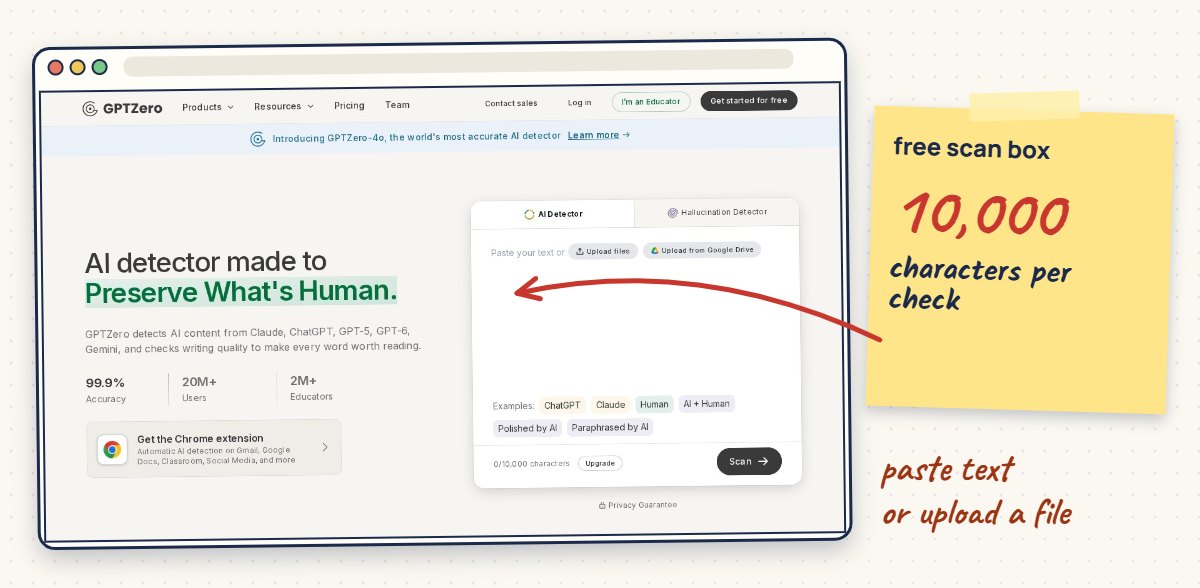
Yes, for basic checks: the box on its homepage accepts up to 10,000 characters per scan. Paid plans add more words per month, file uploads and reports; Premium was $12.99/month billed yearly in October 2026.
Which is more accurate, GPTZero or ZeroGPT?
GPTZero publishes a versioned benchmark you can examine; we did not find a comparable public benchmark for ZeroGPT’s figures. Neither should be used as proof on its own.
Can detectors be unfair to English learners?
A 2023 study found older detectors flagged most essays by non-native writers. A 2026 study in Czech did not find that bias in newer detectors. Until there is more evidence, take extra care with students writing in a second language.
Screenshots were saved in October 2026; interfaces and plans may change. Figures quoted from companies are their own claims. GPTZero, ZeroGPT and Turnitin are trademarks of their owners; Worksheet365 is not affiliated with them. Our editorial approach · Affiliate disclosure