Learning Guides · Study Tools · Exam planning
A study schedule that works is not a list of hours. It is a list of topics, spread out, with each one coming back a few times before the test:
- List every topic for each exam and mark it shaky, okay or solid.
- Count your real study days, then start a new topic every few days so the last one is learned before the final day.
- Bring each topic back about 1, 3, 7 and 14 study days later, in short sessions where you quiz yourself instead of rereading.
- Keep the day before the exam for a quick last look, and keep one day a week completely off.
About the links: the calculator on this page is free and saves nothing. Further down we mention our own Exam Study Planner, a paid printable kit and spreadsheet sold on our Gumroad shop. We make it, so we are not neutral about it. Our disclosure.
Why spacing beats cramming
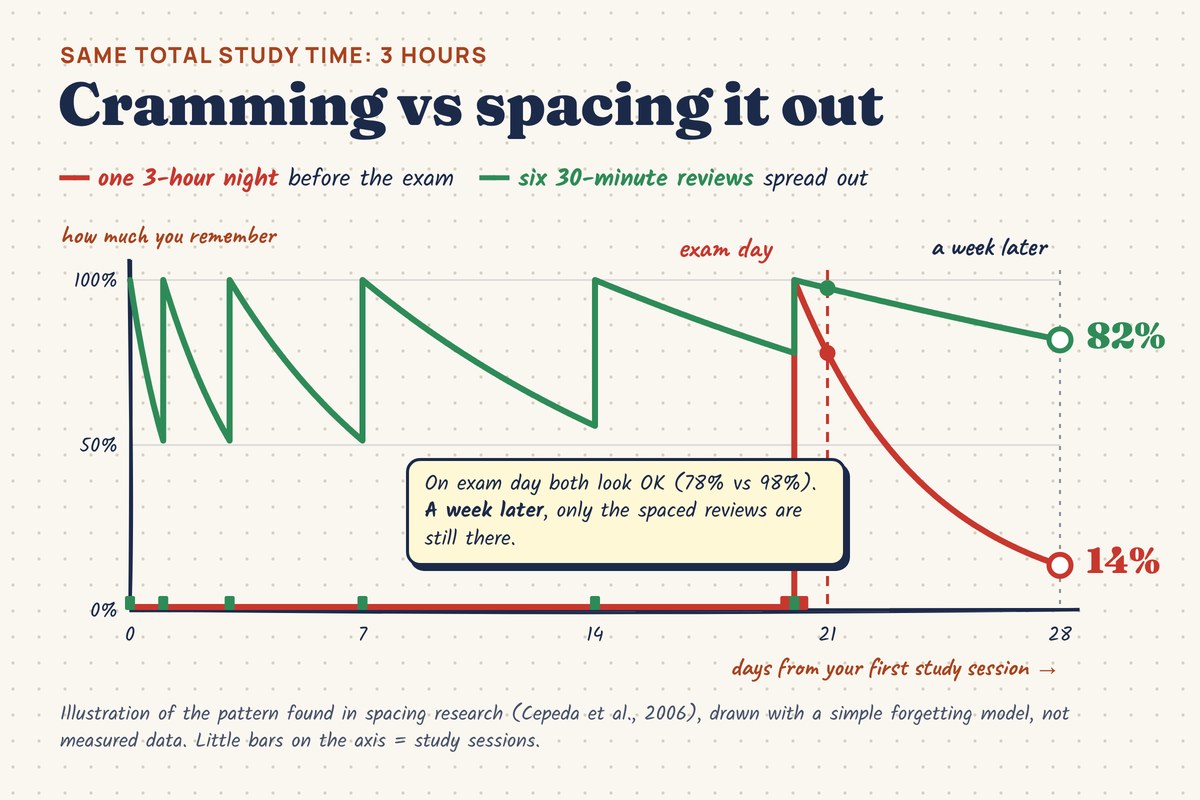
Most students who “studied for hours” and still blanked did one thing: they met each topic once, usually close to the test, and read it again until it felt familiar. Familiar is not the same as remembered.
Build your schedule in 5 steps
- Write down every exam with its date, time and format. Ask about anything you are unsure of now, not the week before.
- List every topic from the syllabus or review sheet. Without opening your notes, mark each one shaky (I could not explain it), okay or solid (I could teach it).
- Count study days, not calendar days. Take out days you truly cannot study: work, games, travel, family. Leave the day before each exam free of new topics.
- Spread the first sessions. Divide study days by topics. If you have 24 study days and 8 topics, start a new topic every 3 days. Shaky topics go first.
- Add the reviews. Each topic comes back after a growing gap. Reviews are short: 10 to 15 minutes of flashcards, practice questions or writing down all you remember.
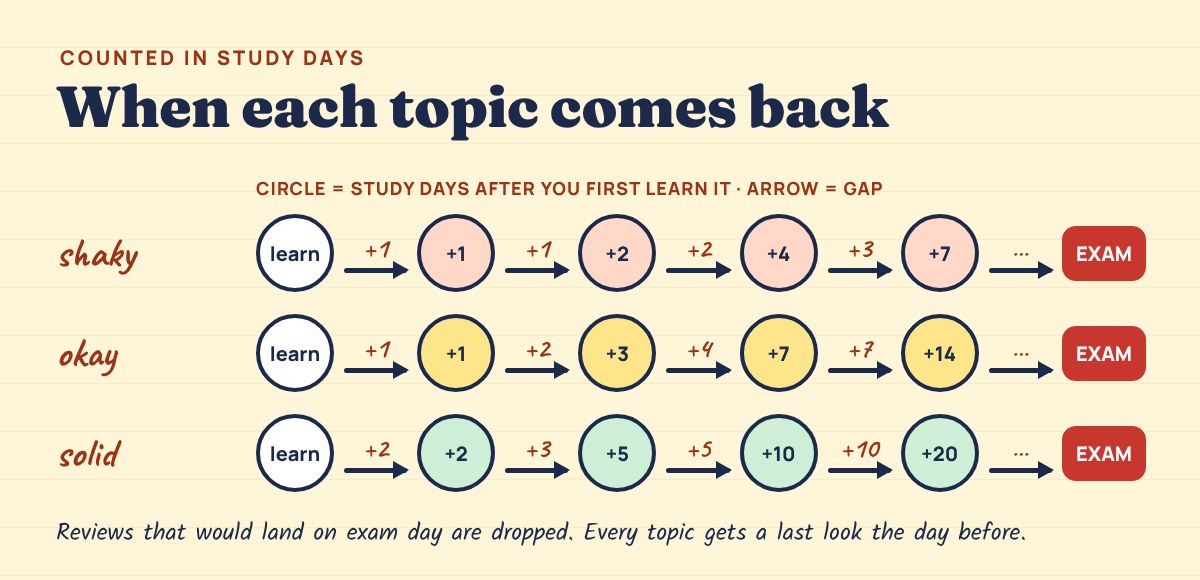
These gaps are a rule of thumb inspired by the research above, not a number from one study. If your exam is only ten days away, shorten them; the idea of growing gaps still holds.
Free review-date calculator Try it now
Enter your dates and number of topics. It tells you how often to start a new topic and lists every review date. Nothing is saved or sent.
Gaps are counted in study days. Reviews that would fall on or after the exam are dropped, and every topic gets a last look on the study day before the exam.
What a good week looks like
Once the schedule is running, a normal day has one new topic (30 to 45 minutes) and two or three short reviews of older ones. A good week also has:
- One timed practice test, then ten minutes logging where you lost marks. The same leak twice tells you what to study next.
- One rest day. Sleep after learning helps memory more than an extra late hour.
- Ten minutes on Sunday to move anything you missed. Missed reviews go first; new topics can wait a day.
Mistakes that break a schedule
- Planning hours instead of topics. “Study biology 2 hours” ends with rereading. “Quiz myself on cell transport, 15 minutes” ends with a result.
- Filling every day. A plan with no slack falls apart after the first busy evening. Leave one day off and one catch-up slot.
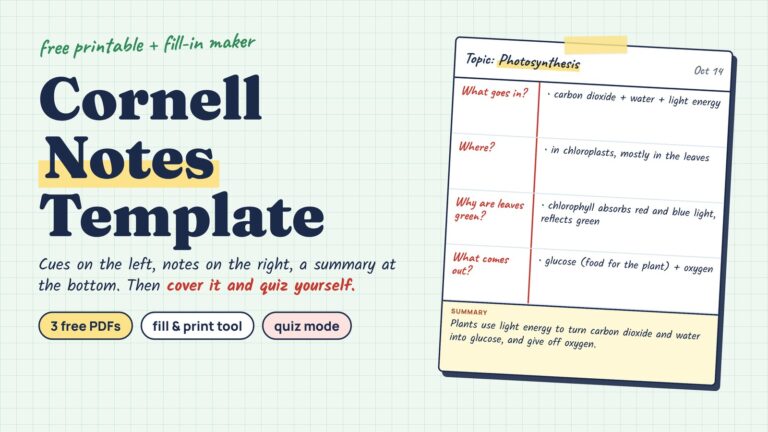
- Notes you cannot quiz yourself on. If your notes are one long block, reviews turn into rereading. A Cornell notes page puts a question next to every chunk, ready for your review days.
- Skipping reviews because a topic “feels fine”. The feeling comes from recognising the page. Test yourself before you skip.
- Starting new topics the night before. The last day is for a quick look over your summaries, packing your bag and sleeping.
+ Paper, app or spreadsheet? From our shop

The calculator above handles one exam. If you have several, or you want the reviews tracked for you, we built a fuller version: the Exam Study Planner.
★ Teaching this in class? For teachers

Our printable unit Stop Cramming: Spaced Practice That Sticks turns this guide into ready-to-teach lessons: 20 pages, five games, grades 6-12, no prep.
Questions
How many hours a day should I study for exams?
There is no magic number. Plan in sessions instead: one new topic and two or three short reviews a day is enough for most students over three to four weeks. If that does not fit, start earlier rather than staying up later.
How far ahead should I start a study schedule?
For a big exam, three to four weeks gives each topic room for four reviews. With two weeks, use shorter gaps (1, 2, 4, 7 days). With less than a week, focus on practice questions for your shakiest topics.
What is the 1-3-7-14 method?
It is a simple spaced review rhythm: after you first learn a topic, you review it 1, 3, 7 and 14 days later. It is a rule of thumb based on research about spacing, not a fixed scientific formula, so adjust it to your exam date.
Should I study one subject per day or mix them?
Mixing usually works better once you know the basics: a new topic from one subject and reviews from others. For maths and science problems, mixing question types also prepares you for how the exam will look.
What should I do the night before an exam?
A short last look at your summaries or hardest flashcards, then pack your bag, check the time and room, and sleep. No new topics.
Sources: Roediger & Karpicke (2006), Psychological Science 17(3); Cepeda et al. (2006), Psychological Bulletin 132(3); Dunlosky et al. (2013), Psychological Science in the Public Interest 14(1). Illustrations are drawn by Worksheet365 to explain the ideas; they are not data plots. Our editorial approach · Disclosure