Is Using AI Cheating? Where the Line Is (+ a 60-Second Checker)
Using AI isn't automatically cheating. Where the line is, what 1,391 teens told Pew, the 5 levels teachers use, and a free 60-second checker.
Learning Guides · AI & Integrity · Using AI for school
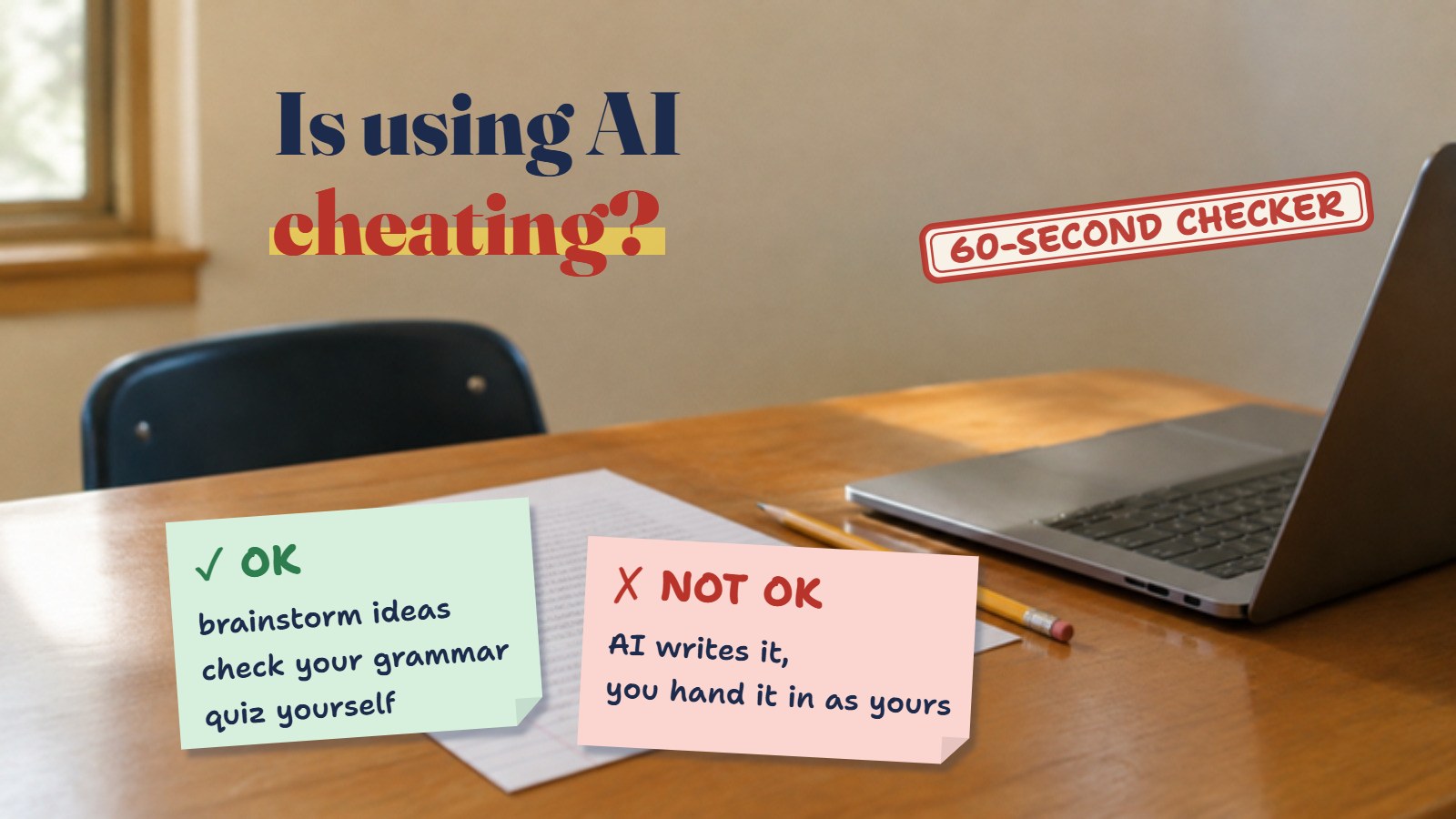
Using AI is not automatically cheating. It turns into cheating in two situations:
- AI does the part of the work your teacher is grading (the thinking, the writing, the solving), and you hand it in as yours.
- You use it in a way your class rule doesn’t allow, or you hide that you used it.
Not sure? Ask before, say what you used after. The checker below does the sorting for you in about a minute.
We’re a study-skills site, not your school. If your teacher or school has an AI rule, that rule wins over anything on this page.
Why there’s no simple yes or no
Picture two students with the same chatbot open. Maya asks it to explain photosynthesis three different ways until it clicks, then writes her lab conclusion herself. Leo pastes the lab question in and copies the answer. Same tool, same five minutes. One of them learned something; the other one rented a grade.
That’s the whole idea: the question isn’t “did you use AI?” but “which job did you hand over?” If the job your teacher wants to see is your explanation, giving that job to a chatbot is the problem. Getting help to understand the topic usually isn’t.
And no, AI didn’t invent cheating. Stanford researchers who have surveyed high schoolers for more than 15 years found that about 60 to 70% of students already reported some cheating behavior in the previous month before chatbots existed, and in their 2023 surveys that share stayed about the same or dipped slightly. The tool changed; the temptation didn’t.
What other students think
Teens mostly agree on the extremes. In a Pew Research Center survey of 1,391 U.S. teens (fall 2024), here’s how many called each use of ChatGPT acceptable or not:
Researching new topics
Solving math problems
Writing essays
Green = “acceptable”, copper = “not acceptable”. The rest weren’t sure. Source: Pew Research Center, survey of U.S. teens ages 13–17, Sept. 18–Oct. 10, 2024.
Notice the pattern: using AI to learn (research) gets a green light from most teens; using AI to produce the thing you’re graded on (an essay) gets the opposite. Math sits right in the middle, which is exactly why it causes so many arguments. The same survey found 26% of teens had used ChatGPT for schoolwork, double the 13% from the year before, so this question isn’t going away.
Stanford’s focus groups heard the same thing in students’ own words: chatbots for “starter” help like explaining a concept or brainstorming ideas felt fair to most students; having one write a whole paper did not.
The 5 levels many teachers use
More and more teachers don’t say “AI yes” or “AI no”. They pick a level for each assignment. A widely used framework, the AI Assessment Scale by Perkins, Roe, Furze and MacVaugh, works like a ladder. In plain English:
- 1 · No AI. You show what you can do on your own, often in class.
- 2 · AI for planning. Brainstorming, outlining, first research. The final work is yours.
- 3 · AI collaboration. AI can help draft or give feedback, and you’re graded on how you judge and reshape what it gives you.
- 4 · Full AI. AI use is expected. What counts is how well you direct it and check it.
- 5 · AI exploration. Creative projects built around AI, sometimes designed with your teacher.
If your teacher hasn’t told you the level, that’s not permission. It’s a question to ask.
The 60-second checker Free
Pick your teacher’s rule and what AI did (or what you’re about to ask it). You’ll get a green, yellow or red answer, plus a ready-to-paste sentence for saying how you used it.
1. What does your teacher allow for this assignment?
2. What did AI do? (tick all that apply)
Tick at least one thing AI did.
3 gray areas students ask about
1 Grammar and rewording tools
Fixing commas and typos is usually treated like spell-check. Rewriting whole sentences “to sound better” is different: the wording is no longer yours. On a level 1 or 2 task, that’s over the line.
2 Math homework
Asking for a hint, or checking your answer after you solved it, keeps the thinking yours. Copying the steps for a problem you never tried is handing over the exact skill the homework is there to practice, and tests will show it.
3 “I’ll just put it in my own words.”
Paraphrasing an AI answer still hands in the AI’s ideas and structure. If the task is to show your thinking, rewording someone else’s thinking doesn’t count, whether that someone is a website, a friend or a chatbot.
How to say you used AI
Being upfront turns most gray areas into a non-issue. Two easy habits:
1. A one-line note at the end of your work, like: “AI use: I used ChatGPT to brainstorm ideas and quiz myself. The final wording and ideas are mine, and I checked every fact.” The checker above writes this sentence for you.
2. A reference, if your class uses APA. APA’s 2025 guidance says to name the company as author and cite either the tool in general or a specific chat. For the tool in general, the pattern is: OpenAI. (2025). ChatGPT [Large language model]. https://chatgpt.com, and in your text (OpenAI, 2025). Prompts don’t go in the reference; describe them in your text or an appendix if your teacher wants them.
Keep your drafts and your chat history. If anyone ever questions your work, version history and notes show your process better than any argument.
Two printable units from our store turn this page into class activities, with real examples and answer keys.
 How to Study with AI and Actually Remember ItStudy-skills workbook · $6 on TPT ↗
 AI Fact-Checking UnitVerify AI answers, spot fake sources · $7 on TPT ↗
Studying for exams without shortcuts? The Exam Study Planner builds your review schedule for you, and the free 24-page Study Starter Kit is one click away.
Questions
Can my teacher tell if I used AI?
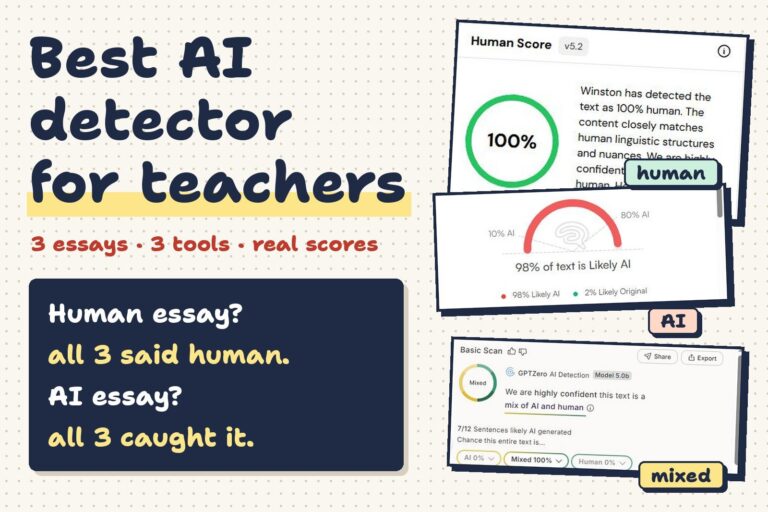
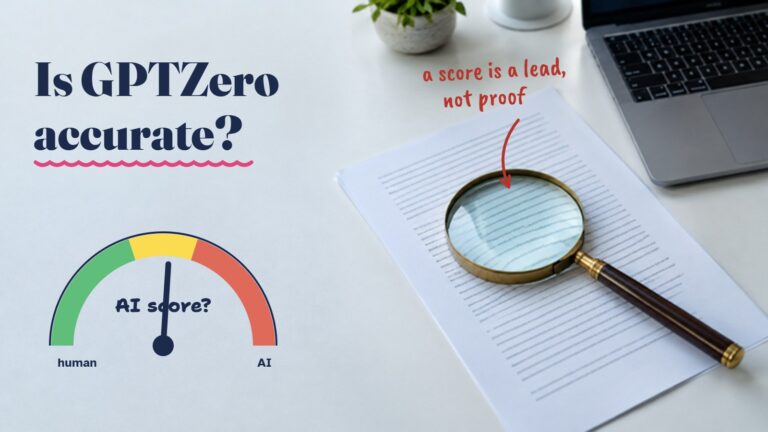
Sometimes, but not reliably from a detector score alone. AI detectors make mistakes, which is why many teachers look at drafts, version history and a quick conversation instead. We break down the numbers in Is GPTZero accurate? The honest route is simpler: follow the rule and say what you used.
Is using AI to study cheating?
Usually not. Asking a chatbot to explain a topic or quiz you before a test is studying, not handing in work. It becomes a problem when the AI’s output is what you submit for a grade, or during a test where AI isn’t allowed.
Is Grammarly or a rewording tool cheating?
It depends on what it changes. Fixing spelling and punctuation is usually fine. Rewriting your sentences or paragraphs means the wording isn’t yours anymore, so check your assignment’s AI level first.
I already used AI and didn’t say so. What now?
Talk to your teacher before it comes up on its own. Explain what you used it for, show your drafts, and offer to redo the part AI did. Owning it early almost always goes better than being asked about it later.
The bottom line
AI is a tool, like a calculator or a tutor. It’s cheating when it does the part you’re graded on, or when you break your class rule and keep quiet about it. Learn with it, don’t hand it the homework, and when in doubt: ask before, say it after. Looking for tools that help you learn? See our tested list of 15 AI tools for students, each marked with what’s OK for school. Planning a big exam week? Our study schedule guide spreads the work out so shortcuts never look tempting.
Sources
- Pew Research Center (Jan. 15, 2025). About a quarter of U.S. teens have used ChatGPT for schoolwork.
- Stanford Graduate School of Education (Oct. 31, 2023). What do AI chatbots really mean for students and cheating?
- Perkins, Roe, Furze & MacVaugh. The AI Assessment Scale (current version 2.1).
- APA Style (Sept. 9, 2025). Citing generative AI in APA Style: Reference formats.
ChatGPT and Grammarly are trademarks of their owners; Worksheet365 is not affiliated with them. Our editorial approach · Affiliate disclosure