Why You’re Always Late on Big Projects (The Planning Fallacy + a 3-Step Fix)
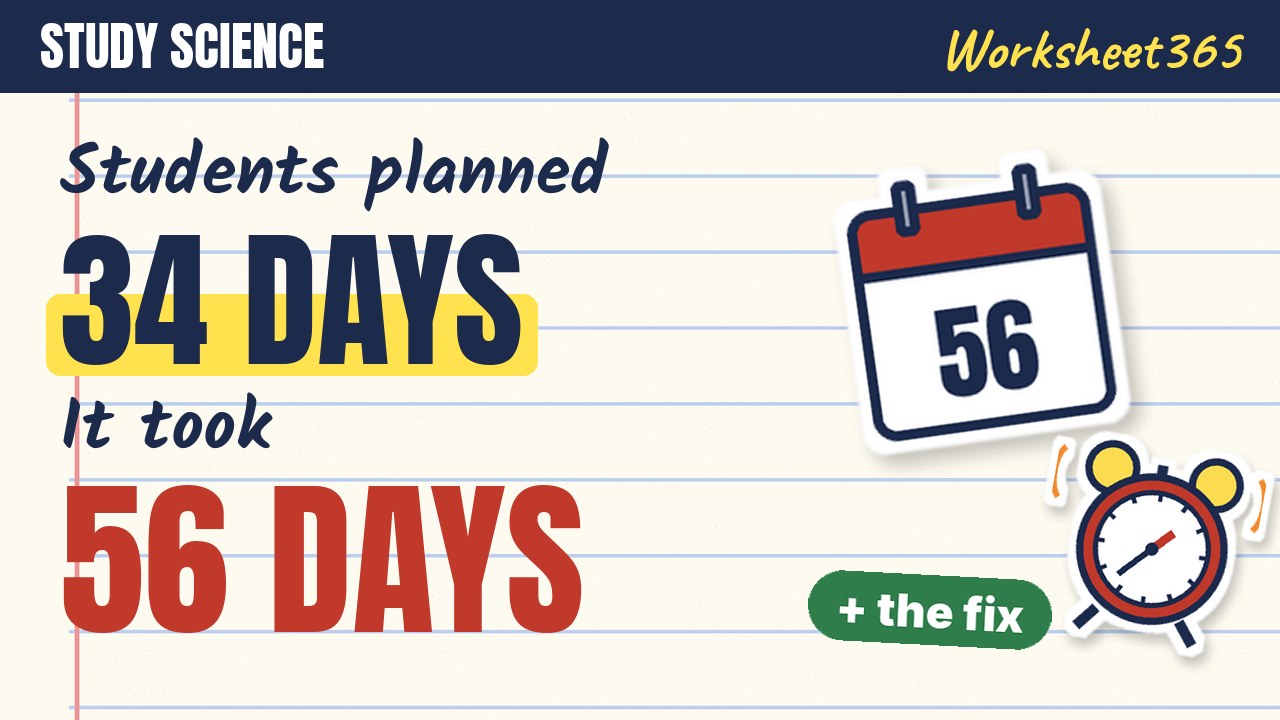
Students planned 34 days for their thesis and needed 56. Here's why we always underestimate big projects (the planning fallacy) and a simple 3-step fix, with a 45-second video.
You give yourself three weeks for a project, and three weeks later you’re only halfway there. It isn’t laziness, and it isn’t just you. Psychologists have a name for it, the planning fallacy, and a famous study of thesis students shows how big the gap really is. Here’s what they found, why it happens, and a simple 3-step fix you can use on your next big assignment.
Quick answer: students guessed they’d finish their thesis in about 34 days. It actually took 56. Even their worst-case guess (49 days) was too short, and only about 30% finished on time.
- We plan for our best-case selves and forget everything that usually goes wrong.
- Break the project into small steps.
- Give each step its own deadline.
- Set your finish date one week before the real one.
The study: 34 days planned, 56 days taken
In 1994, psychologists Roger Buehler, Dale Griffin and Michael Ross asked 37 senior students writing an honors thesis a simple question: when will you finish? They also asked for a realistic guess and a worst-case guess, the date they’d finish “if everything went as poorly as it possibly could.”
| What students predicted | Average |
|---|---|
| Their best guess | about 34 days |
| Their worst-case guess | about 49 days |
| What actually happened | about 56 days |
Read that middle line again: these students were asked to imagine everything going wrong, and reality was still a week worse than their worst case.
Why it happens: we plan for our best-case selves
Daniel Kahneman and Amos Tversky named the planning fallacy in 1979. When you plan, you picture the project going smoothly: you sit down, you work, you finish. What you don’t picture is the cold that costs you two days, the source you can’t find, the other class that piles on homework the same week. You know those things happen (they happened last time), but they don’t feel like part of this plan.
That’s why “just try harder to be realistic” doesn’t work. The fix is to change how you plan, so the hidden work and the surprises are built in.
The 3-step fix
- Break the project into small steps. “Write my essay” hides a lot of work. Outline, research, draft, revise and proofread don’t. Research by Kruger and Evans (2004) found that people who listed the parts of a task gave longer, more realistic time estimates.
- Give each step its own deadline. One far-away due date is easy to ignore. Four close ones aren’t. Put them in your planner, and if a step runs late, you’ll see it while there’s still time to catch up.
- Set your finish date one week before the real one. That week is your buffer for everything you didn’t plan for. If nothing goes wrong, you hand it in early and relaxed.
Want help putting the steps on a calendar? Our study schedule for exams guide has a free calculator that gives you every review date, and the same method works for essays and projects.
Frequently asked questions
What is the planning fallacy?
It’s our tendency to underestimate how long a task will take, even when we know similar tasks took longer in the past. Kahneman and Tversky described it in 1979.
How much do students underestimate?
In Buehler, Griffin and Ross’s 1994 study, thesis students predicted about 34 days and needed about 56. Only about 30% finished by their predicted date.
Does breaking a task into steps really help?
Yes. Listing the parts of a task makes the hidden work visible, and studies such as Kruger and Evans (2004) found it leads to longer, more realistic estimates.
How big should my buffer be?
For a school project, a week before the real deadline is a good start. For a short assignment, a day or two. If you’re often late, make it bigger.
The bottom line
Being late on big projects isn’t a character flaw. It’s the planning fallacy, and almost everyone has it. Break the work into steps, give every step a deadline, and finish a week early on purpose. Your future self will thank you. Finals coming up? See what you need on each one with our free final exam calculator, then plan backwards from there.
Get the 24-page Study Starter Kit: planners, quizzes, a 30-day challenge and a focus timer.